Be the first to hear about new events as they drop.Be first to hear about new events.
Thank you. Check your inbox and click the link to confirm.
The book · Questions men ask
Survival mode: the signs, and how to get out of it
Survival mode is when your body stays braced for the next problem long after the last one has passed. You get through the day, and the one after, but everything runs on adrenaline and habit, with nothing left over for rest, people or the things you used to enjoy. It’s a stress response, not a flaw in you, and it’s something your body can come down from.
I ran on it for years.
I spent thirty years hosting events. I could walk into a room and tell within seconds how everyone in it was feeling, but I had no idea how I was feeling myself. I was always on: checking, planning, bracing for the next thing to go wrong. When it got too loud I reached for whatever was nearest, a drink, a bet or a smoke, and called it unwinding.
None of that switched it off. It made me feel better for one night and worse the next morning. What finally shifted it was working with my body directly, a few minutes at a time, until it stopped bracing for trouble all the time.
I was coping so well that I forgot what calm felt like.
What does survival mode actually mean?
Your nervous system has a setting for danger: heart rate up, muscles ready, attention narrowed to whatever might go wrong next. It’s meant to switch on for a crisis and off again afterwards. When the pressure never lets up, whether that is money, a job that never stops, caring for someone or a relationship running on empty, the switch stays on. Your body starts treating ordinary life as the emergency.
Survival mode isn’t a medical diagnosis. It’s an everyday name for a long-running stress response, and it overlaps with burnout, anxiety and functional freeze, where the same stress response leaves you feeling flat and numb instead of on edge.
How can you tell you are in it?
You’re never fully off. Even on a day off, part of you is scanning for the next problem.
Sleep doesn’t refill you. You wake at 3am with your head already at work.
Your fuse is short. A slow driver or a question asked twice lands like an attack.
You live day to day. Planning anything past the weekend feels pointless.
Your shoulders, jaw or stomach are tight, and have been for so long that you thought it was normal.
You can’t remember the last thing you did just for you.
Rest feels wrong. When you finally sit down, you feel guilty, restless or uneasy.
What puts a person into survival mode?
Usually not one big event but a long run of smaller ones with no recovery between them: years of money worries, a demanding job, looking after children and parents at the same time, a relationship that has gone cold, or an old trauma that taught your body to stay ready. Men often make it worse without meaning to. A drink, a bet or a few extra hours at work take the edge off tonight, but they add to the pressure tomorrow.
The common thread is that the threat never fully ends, so your body never gets the signal that it can stand down.
How do you get your body out of it?
You can’t talk your body out of being on alert. It needs to feel, through the body itself, that it’s safe to relax. These take a few minutes and need nothing but a quiet corner.
Make the out-breath longer. Breathe in through your nose for a count of four and out through your mouth for a count of eight. Do this ten times. A long exhale is one of the quickest signals to your body that the danger has passed.
Feet, then fists. Press both feet into the floor and notice the pressure. Squeeze your fists for five seconds, then let them open. Do this three times.
Widen your view. Slowly turn your head and name five things you can see. A body on alert narrows its focus; looking around tells it there is nothing to watch for.
None of these is a cure. Done most days, they give your body practice at coming down.
How long does survival mode last?
It usually lasts as long as whatever caused it, and often longer. Even when the crisis is over, a body that spent years on alert can keep running the old setting out of habit. That’s why people say “everything has calmed down, so why do I still feel like this?” Your circumstances changed. Your body hasn’t caught up yet.
Why a quiet weekend doesn’t fix it
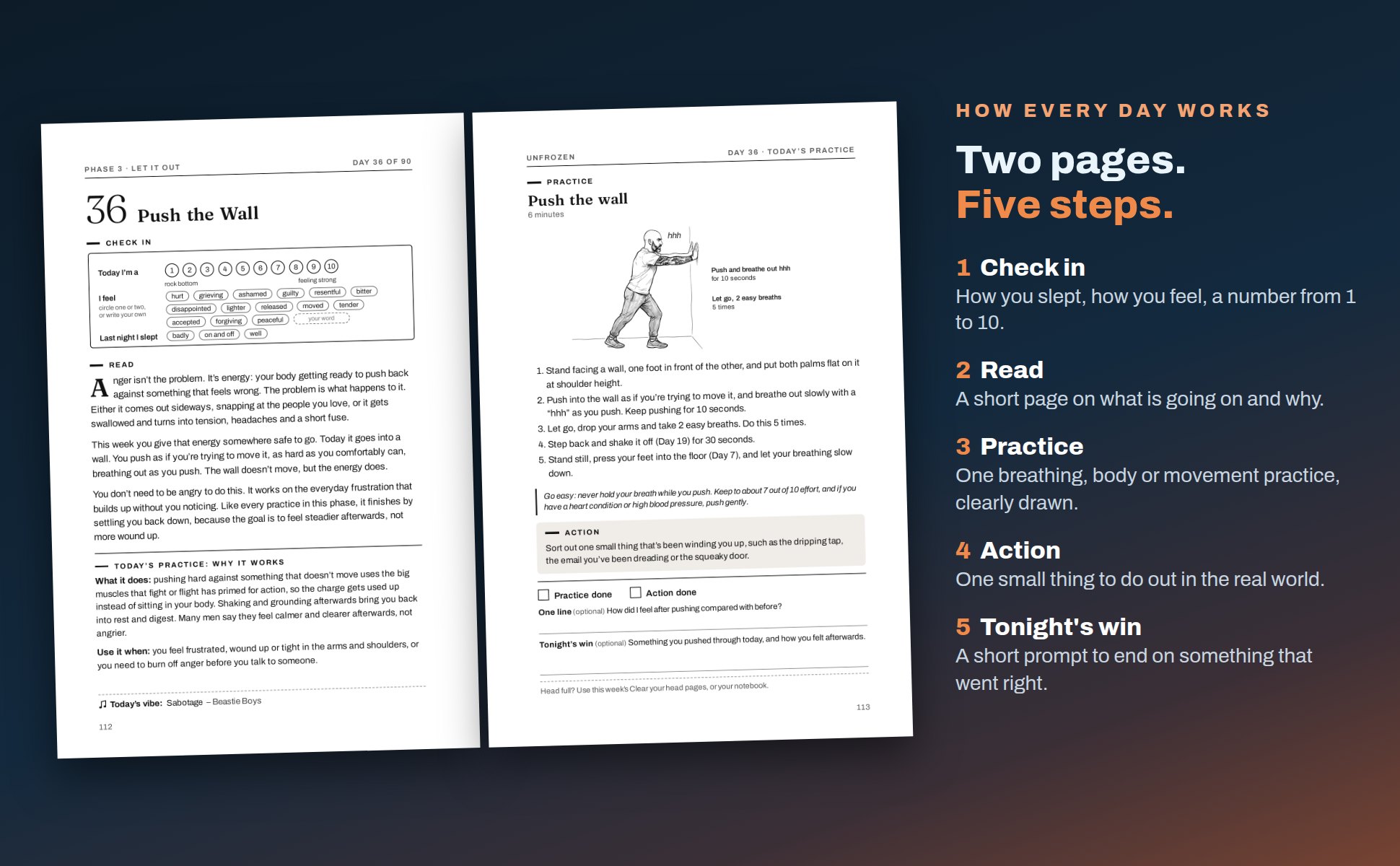
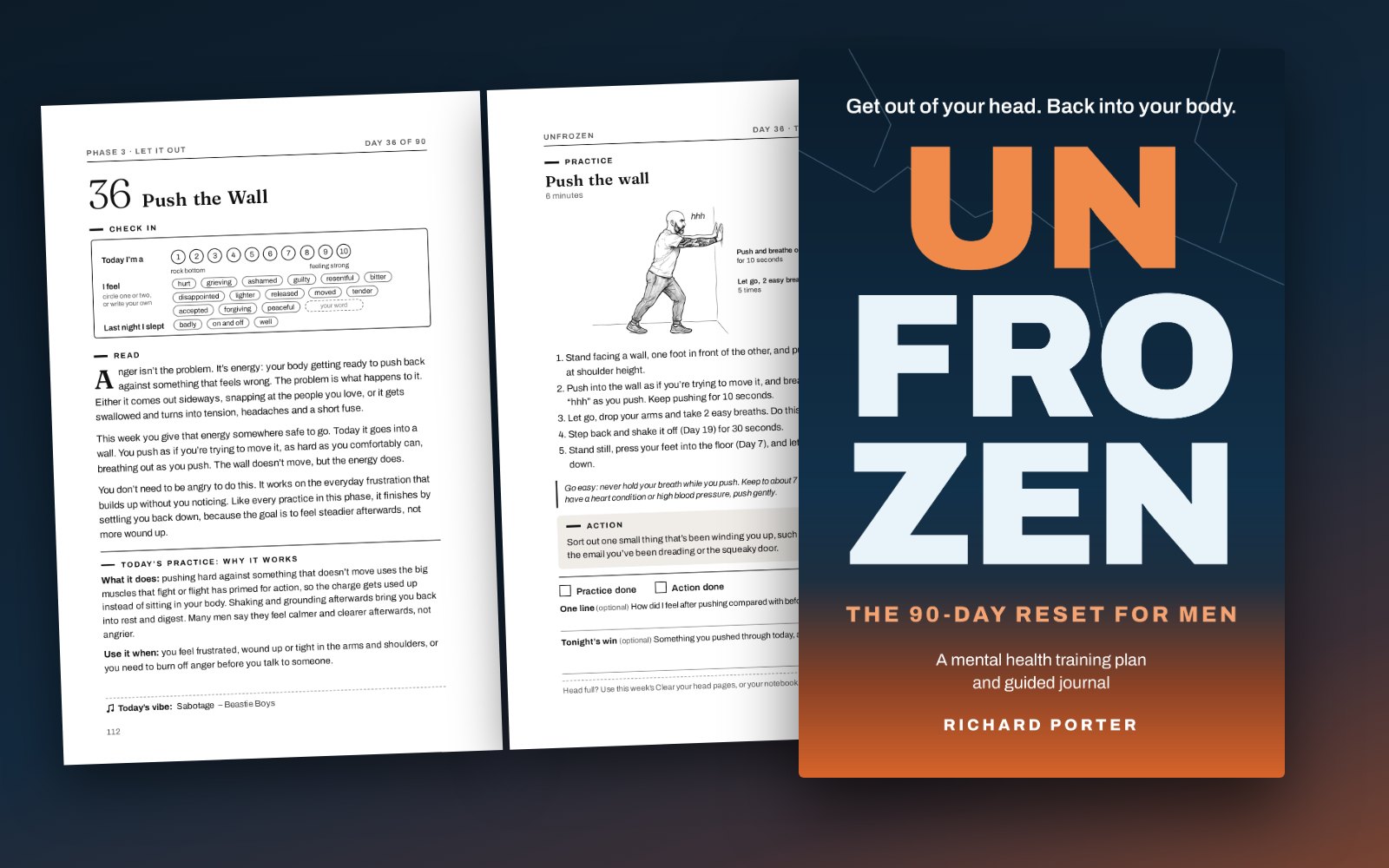
A quiet weekend helps, and then Monday arrives and the alarm goes straight back on. Survival mode is something your body learned over years, so it unlearns through repetition rather than one big rest. The book turns that repetition into a plan you can follow on your own, starting with sleep, food and breath before anything else.
Two pages a day, about ten minutes. You check in, read a short page, do one practice, take one small action and finish on tonight’s win.
Six phases that build on each other, from Stop the Slide (sleep, food, breath) through Back in Your Body and Let It Out, to Build Forward.
A weekly review every seven days, so you can see the change on paper even when you can’t feel it yet.
A safety page with UK helplines, and a section on when coping slips into drink, drugs or gambling.
When to get help now
If you feel hopeless, can’t see a way forward or are having thoughts of ending your life, talk to someone today.
Samaritans: call 116 123, free, day or night.
Shout: text SHOUT to 85258, free, confidential, 24/7.
CALM: call 0800 58 58 58, 5pm to midnight, every day.
NHS 111: in England, choose the mental health option. In Wales, call 111 and press 2. In Scotland, call NHS 24 on 111 and choose option 2. In an emergency, call 999 or go to A&E.
Northern Ireland: Lifeline, 0808 808 8000, free, 24 hours a day.
Andy’s Man Club: free talking groups for men, Mondays from 7pm (not bank holidays), across the UK and online.
See your GP if this has gone on for more than a couple of weeks. Constant tiredness, poor sleep and a racing heart can also come from anxiety, depression, thyroid problems or other physical causes, and those deserve checking.
Questions
Plain answers.
What are the signs your body is in survival mode?
What’s the difference between survival mode and burnout?
Can you be in survival mode without realising?
How do you come out of survival mode?
Prefer to do this in a room with other people? See upcoming sessions in Preston, South Ribble and Chorley
Written by Richard Porter, somatic bodywork facilitator, Preston, Lancashire. This page is for information, not medical advice.
More questions men ask: Functional freeze · Feeling numb · Signs of depression in men · How to be a better man · Feeling stuck in life
Ninety days to stand down.
Unfrozen: The 90-Day Reset for Men. Paperback, 282 pages.
Available on Amazon in the UK.
Buy on Amazon