Be the first to hear about new events as they drop.Be first to hear about new events.
Thank you. Check your inbox and click the link to confirm.
The book · Questions men ask
Signs of depression in men, and how to help
Depression in men often does not look like sadness. It is more likely to show up as anger or irritability, exhaustion, drinking or gambling more, working all hours, pulling away from people and saying “fine” to everyone. Because those signs look like stress or a bad mood, men and the people around them often miss them for months or years.
Why it gets missed
Around three in four suicides in the UK are men, according to the Office for National Statistics. Many of those men never told anyone how bad it had got. That is not because men do not feel it. It is because most of us were taught to deal with it quietly, and to show it, if we show it at all, as something that looks like anything other than pain.
I know that from the inside. For years I told everyone I was fine, while I smoked and gambled my way through the evenings. The people around me saw a man who was a bit short-tempered and always busy. Nobody, including me, called it what it was.
Nobody, including me, called it what it was.
The signs to look for
In his mood
He is irritable, short-tempered or angry over small things.
He seems flat, numb or “not bothered” about things he used to love.
He says “fine” or “just tired” whenever he is asked.
In his body
He is exhausted all the time, yet sleeps badly.
He has more headaches, back pain or stomach trouble than he used to.
His appetite has changed, either eating much less or comfort eating.
In what he does
He is drinking, smoking, gambling or gaming more than he used to.
He works all hours, or cannot face work at all.
He takes more risks, such as driving too fast, spending or picking fights.
He has pulled away from mates, family or the things he used to do.
One or two of these on a bad week is normal. Several of them, most days, for more than two weeks, is a reason to act.
If it is you
You do not need to be sure it is depression to do something about it. Start small: tell one person the true answer to “how are you?”, book a GP appointment, or try one of the free Andy’s Man Club groups, where nobody makes you talk until you want to.
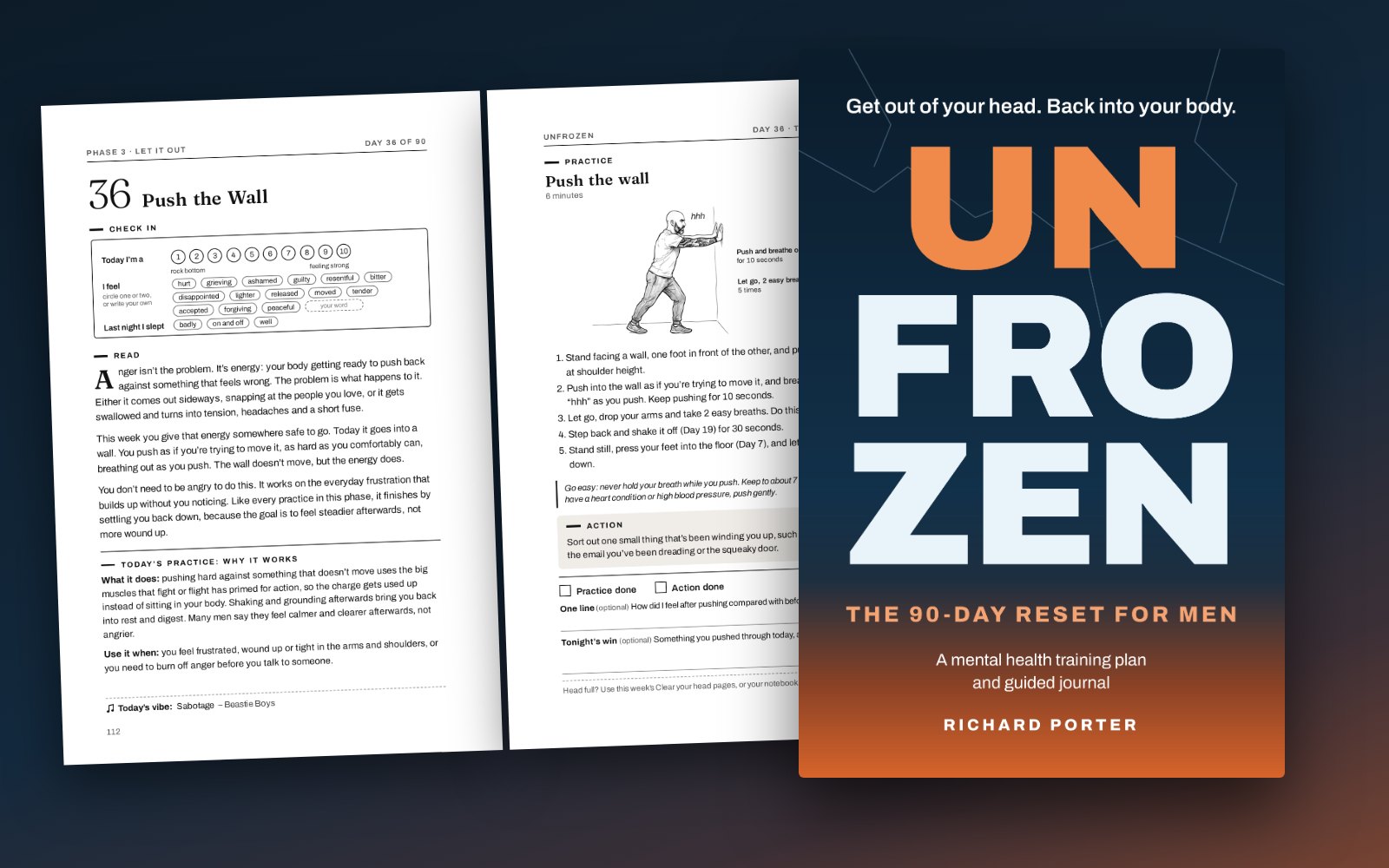
The book exists for exactly this point, when you know something is off but are not ready to talk about it yet. It gives you ten minutes a day, on your own, with a check-in, one breathing, body or movement practice and one small action. It also includes a page on when coping slips into drink, drugs or gambling, and what UK help there is.
If it is someone you love
Men often will not open up when asked straight out. These help more:
Ask twice. “How are you?” gets “fine”. “No, how are you really?” gets more.
Talk side by side, not face to face. Talk in the car, on a walk or while fixing something together. Less eye contact makes it easier for many men.
Do not fix, just listen. You do not need answers. “That sounds hard” is enough.
Name what you have noticed, without diagnosing. “You have seemed knackered and quiet for a while. I am worried about you,” lands better than “I think you are depressed.”
Keep showing up. If he brushes you off, try again another day. It often takes a few goes.
If he will not talk, he might write
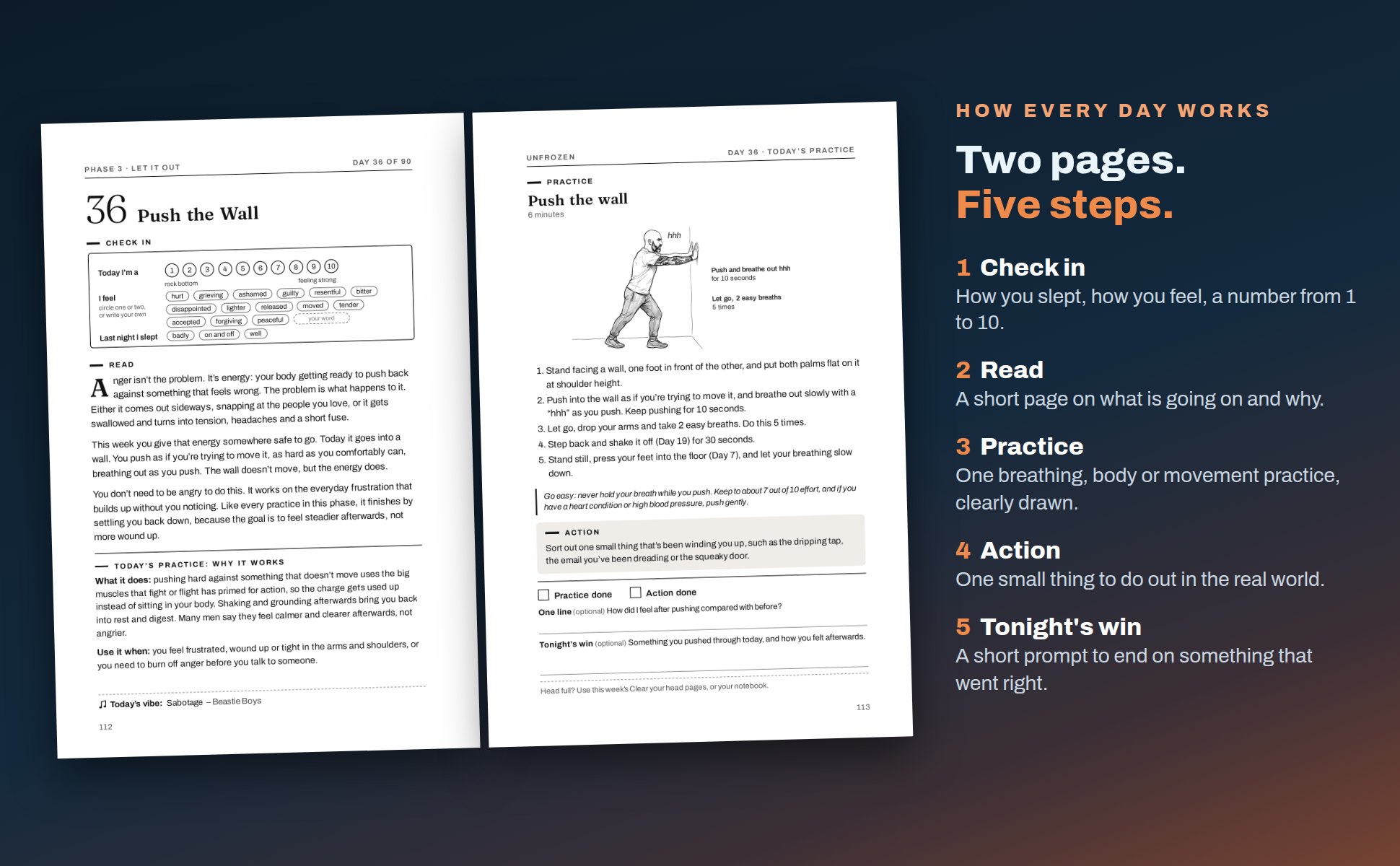
That is one reason I made the book a paperback he fills in privately, at his own pace. Plenty of men will not go near a therapist, but might do ten minutes a day on their own. Giving it to him tells him you have noticed, without forcing a conversation he is not ready for.
Inside, every day follows the same two pages: a check-in, a short read, one breathing, body or movement practice, one small action and tonight’s win. Six phases take him from steadying sleep, food and breath through to reconnecting with people and deciding where he is heading next. There is a safety page with UK helplines, and a section on when coping slips into drink, drugs or gambling.
When to get help now
If he, or you, is talking about not wanting to be here, or about ending his life, get help today.
Samaritans: call 116 123, free, day or night.
Shout: text SHOUT to 85258, free and confidential.
CALM: call 0800 58 58 58, 5pm to midnight, every day.
NHS 111: choose the mental health option in England. In an emergency, call 999.
Andy’s Man Club: free talking groups for men, every Monday at 7pm, across the UK.
A GP is the right first step for depression. It is common and treatable, and a GP can talk through talking therapy, medication and other support.
Questions
Plain answers.
How do I tell if a man is depressed?
What are the symptoms of depression in men over 40?
How can I help a man who is depressed but will not talk?
Is anger a sign of depression in men?
Prefer to do this in a room with other people? See upcoming sessions in Preston, South Ribble and Chorley
Written by Richard Porter, somatic bodywork facilitator, Preston, Lancashire. This page is for information, not medical advice.
More questions men ask: Functional freeze · Feeling numb
For the man who is not ready to talk yet.
Unfrozen: The 90-Day Reset for Men. Paperback, 282 pages.
Available on Amazon in the UK.
Buy on Amazon