Be the first to hear about new events as they drop.Be first to hear about new events.
Thank you. Check your inbox and click the link to confirm.
The book · Questions men ask
Functional freeze: the signs, and how to get out of it
Functional freeze is when you keep doing everything life asks of you (work, bills, school runs, replying to messages) while feeling flat, numb or cut off inside. It is the body’s freeze stress response running quietly in the background. From the outside you look fine, so nobody notices, often not even you.
I lived in it for years.
I went to work, turned up for people and said “fine” whenever anyone asked. Underneath, I was foggy, flat and switched off. I filled the gap with weed and gambling, because both gave me something to feel, or a break from feeling anything at all. On paper I was coping, so nobody pulled me up on it.
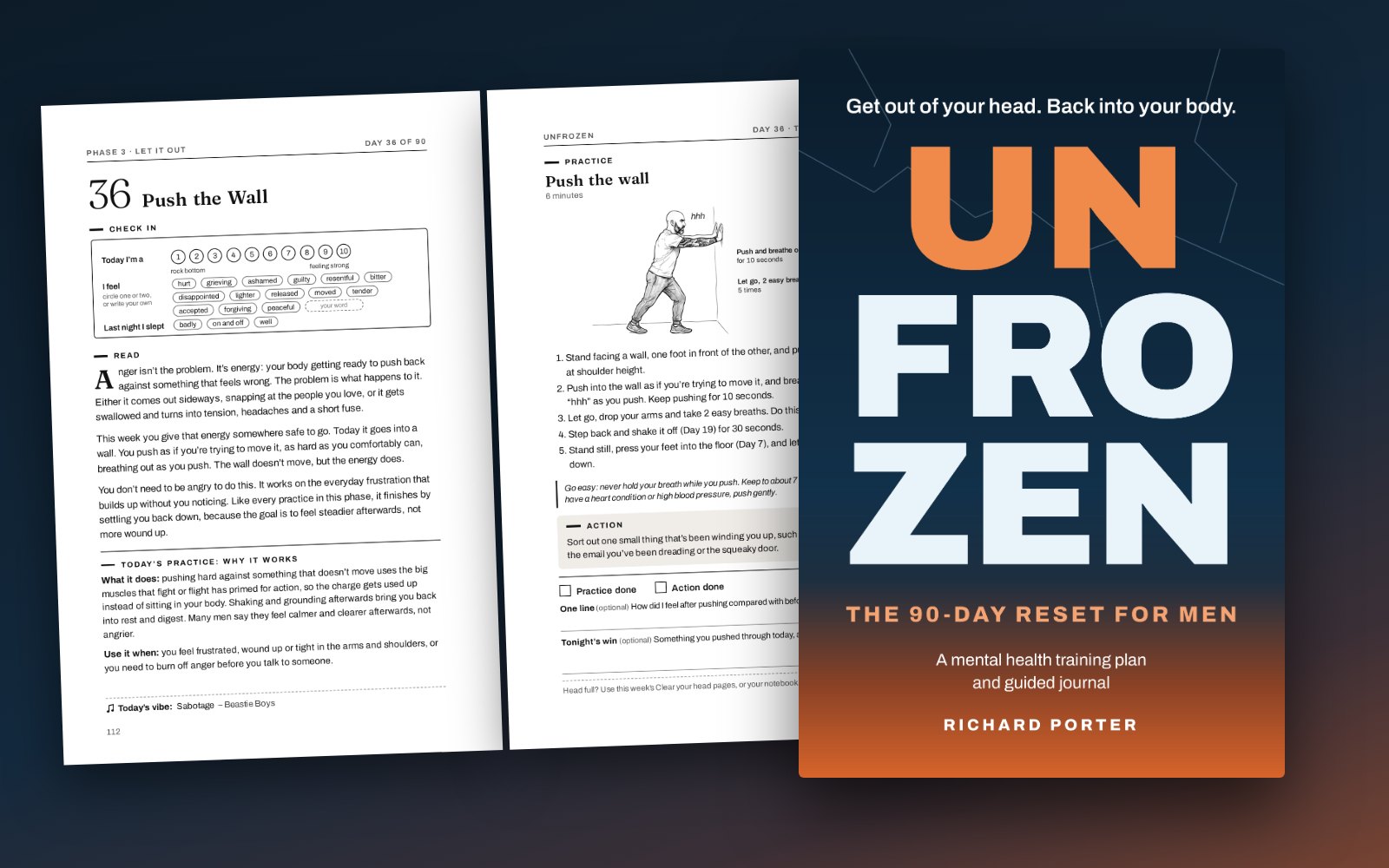
Reading about it did not get me out. I already knew I was stressed. What shifted it was getting back into my body, every day, for long enough that it stuck. I wrote the book so that other men can do that at home without having to work it out on their own first.
On paper I was coping, so nobody pulled me up on it.
What is actually going on?
When the pressure goes on for long enough, your nervous system stops treating it as a short-term problem. Fight or flight (wired, snappy, unable to switch off) is tiring to keep up, so the body turns the volume down instead. You keep functioning, but feeling, energy and drive get dimmed to save fuel.
Functional freeze is not a medical diagnosis. It is a popular name for a shutdown stress response that is well known, and some doctors think the term gets overused. The pattern underneath it is real, though, and most men I meet recognise it before I have finished describing it.
The signs men tend to miss
You are always “fine”. It is the answer you give everyone, including yourself.
Days blur into each other. Work, sofa, phone, bed, repeat, and you could not say what you did on Tuesday.
Things you used to love do nothing for you, whether that is football, music, mates or sex.
Your body is tired, but your head will not stop. You are knackered by 3pm, yet you scroll until 1am.
You are present, but not there. Your kids or your partner are talking, and you are miles away.
You reach for something to feel something, like a drink, a bet, a smoke, a scroll or the gym to the point of injury.
Small decisions feel huge. An email takes twenty minutes; a phone call waits for weeks.
Three things to try tonight
You cannot think your way out of a body state. The body has to get the message that the threat is over. The first two come straight from the book.
Hand on chest. Sit down, put one hand flat on your chest and breathe in through your nose for four, then out slowly for six to eight. Stay there for two minutes. A long out-breath is one of the quickest ways to tell your nervous system it can stand down.
Shake it off. Stand up and shake your hands, then your arms, then your legs, for a minute. Animals shake after a threat to get rid of it. It feels daft. Do it anyway.
Walk, without your phone. Ten minutes outside, at a pace that makes you breathe a little harder. Moving tells your body it is no longer stuck, in a way that sitting and thinking about it never will.
How long does functional freeze last?
It can last weeks or years, because nothing forces it to end. Nothing breaks, so nothing makes you stop. That is the reason to start now, rather than wait until something does break.
Why one good night is not enough
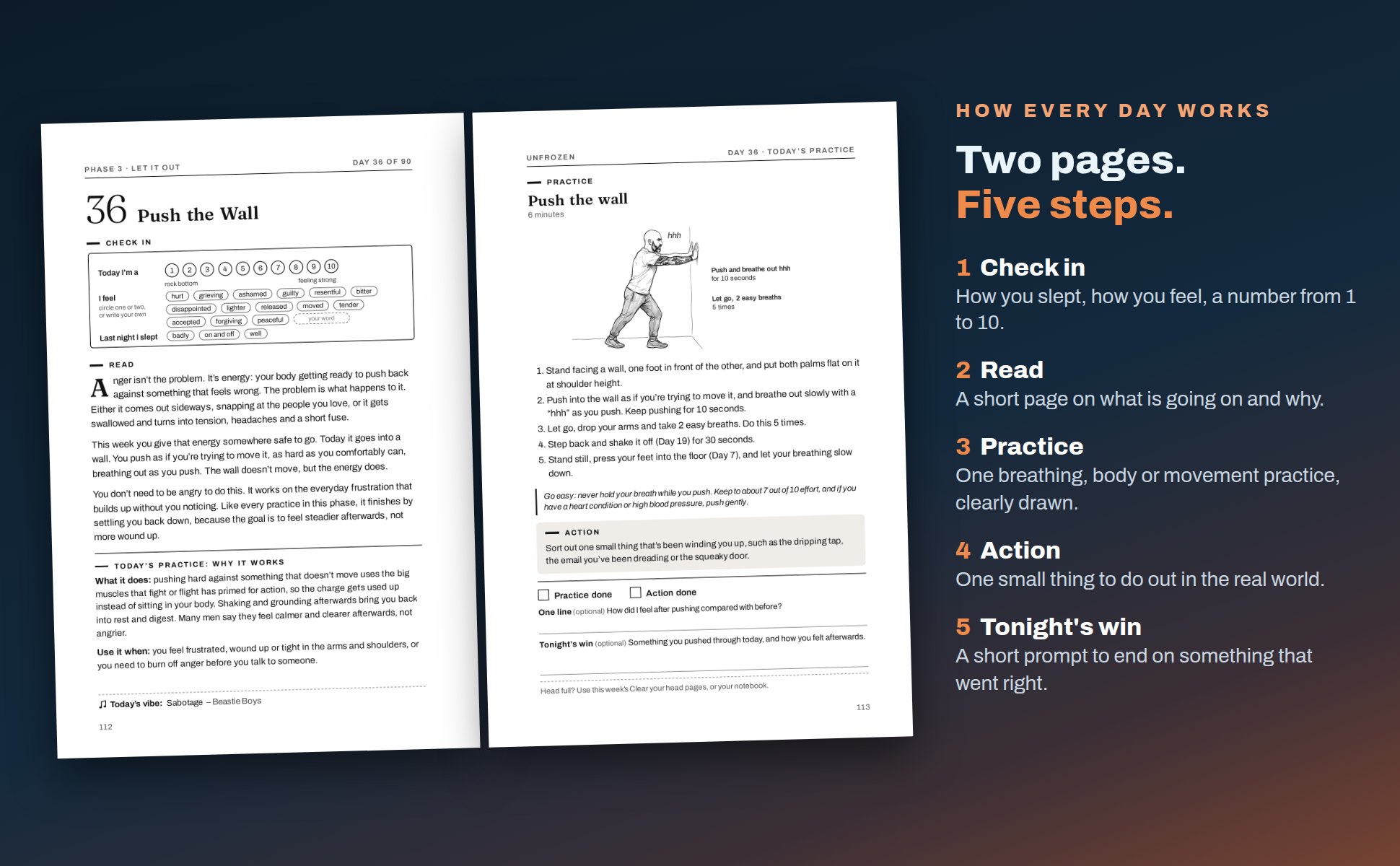
One night of this will feel good. Freeze took months or years to build, though, and it comes back the moment the pressure does. What makes the difference is doing a little every day, for long enough that your body starts to trust it. That is the part most men never manage on their own. It is why I wrote the book, which turns this page into a plan you follow from Day 1 to Day 90.
Two pages a day, about ten minutes. You check in, read a short page, do one practice, take one small action and note tonight’s win.
Six phases that build on each other, from Stop the Slide (sleep, food, breath) through Back in Your Body and Let It Out, to Build Forward.
A weekly review every seven days, so you can see the change on paper even when you cannot feel it yet.
A safety page with UK helplines, and a section on when coping slips into drink, drugs or gambling.
When to get help now
If you feel hopeless, cannot see a way forward or are having thoughts of ending your life, talk to someone today.
Samaritans: call 116 123, free, day or night.
Shout: text SHOUT to 85258, free and confidential.
CALM: call 0800 58 58 58, 5pm to midnight, every day.
NHS 111: choose the mental health option in England. In an emergency, call 999.
Andy’s Man Club: free talking groups for men, every Monday at 7pm, across the UK.
See your GP if this has gone on for more than a couple of weeks. Numbness and exhaustion can also come from depression, thyroid problems, low testosterone or medication, and those deserve checking.
Questions
Plain answers.
What are the symptoms of functional freeze?
How do you fix a functional freeze?
Is functional freeze the same as depression?
Can a journal help with functional freeze?
Prefer to do this in a room with other people? See upcoming sessions in Preston, South Ribble and Chorley
Written by Richard Porter, somatic bodywork facilitator, Preston, Lancashire. This page is for information, not medical advice.
More questions men ask: Feeling numb · Signs of depression in men
Ten minutes a day, for ninety days.
Unfrozen: The 90-Day Reset for Men. Paperback, 282 pages.
Available on Amazon in the UK.
Buy on Amazon