Be the first to hear about new events as they drop.Be first to hear about new events.
Thank you. Check your inbox and click the link to confirm.
Feeling numb: why you feel nothing, and what helps
By Richard Porter. Last reviewed 3 November 2026.
Feeling emotionally numb means the highs and the lows have both gone quiet. Good news lands flat, bad news barely registers, and you go through the day on autopilot. It’s usually a protective response: when there has been too much stress, pain or pressure for too long, the mind turns the volume down on everything, not just the bad stuff.
I smoked my way through it for fifteen years.
For a long time, numb was where I lived. I smoked weed most nights for about fifteen years, and I gambled, and I told myself it was how I relaxed. The truth is that I didn’t want to feel what was underneath, and both of those kept it nicely out of reach. The problem with numbing the bad feelings is that the good ones go with them. I couldn’t remember the last time I had properly laughed, or properly cried.
I didn’t think my way back. I came back through my body first, and the feelings followed. The book is the daily version of what I did.
The problem with numbing the bad feelings is that the good ones go with them.
Why am I not feeling any emotions?
Numbness isn’t the absence of feeling. It’s feeling that has been switched off at the mains, usually for a reason. The common reasons are:
Long-term stress or burnout. Months of running on alert leave nothing over for joy or grief.
Something painful you never dealt with, such as a loss, a break-up, a trauma or a childhood where feelings weren’t welcome.
Depression. Flatness and loss of pleasure can be signs of it, not just sadness. The NHS lists having no interest in things and getting no enjoyment out of life among the symptoms.
Drink, weed, gambling or constant scrolling, which numb on purpose and then keep you there.
Medication. Some antidepressants can blunt emotions. In a 2009 qualitative study of interviews and online forum posts, some people taking SSRIs described flattened emotions and feeling detached. If you think yours might be doing this, talk to your GP before changing anything.
Men are often taught early that feelings are something to get under control. Do that for twenty years and switching them off becomes automatic, so the off switch can get stuck.
Is emotional numbness dangerous?
Numbness on its own isn’t an emergency, but it’s a warning light worth taking seriously. It makes it easier to drift from people, and to reach for something risky just to feel anything. If numbness comes with hopelessness, or with thoughts that people would be better off without you, please use the helplines further down this page today.
Small ways to start feeling again
You can’t force a feeling back, so the trick is to start with the body, which is easier to reach. Most of these come from the book.
Start with sensation, not emotion. Twice a day, stop and notice three things you can physically feel: your feet on the floor, the weight of your hands, the air on your face. Feeling your body is the doorway back to feeling anything else.
Get your heart rate up. Five minutes of stairs, a hard walk or press-ups until you’re out of breath. A body that is working hard is hard to stay numb in, and you’ll often notice a feeling arrive straight after.
Play a song that used to get you. Music reaches feelings that thinking can’t. The book has a song for every day, with a 90-track playlist, for exactly this reason.
Find a better word than “fine”. Is it flat, empty, heavy or tired? Naming it, even “nothing”, is a start. The book builds up 84 feeling words over the 90 days, a few at a time.
Notice what you use to numb. For one week, write down what you reach for at the end of the day. You don’t have to stop anything yet. Just see it.
Why this needs more than one good day
The feelings tend to come back slowly and unevenly, often irritation or sadness first, which can feel like going backwards. It isn’t. It usually means the system is coming back online. This is where most men give up, because nobody told them that is how it goes.
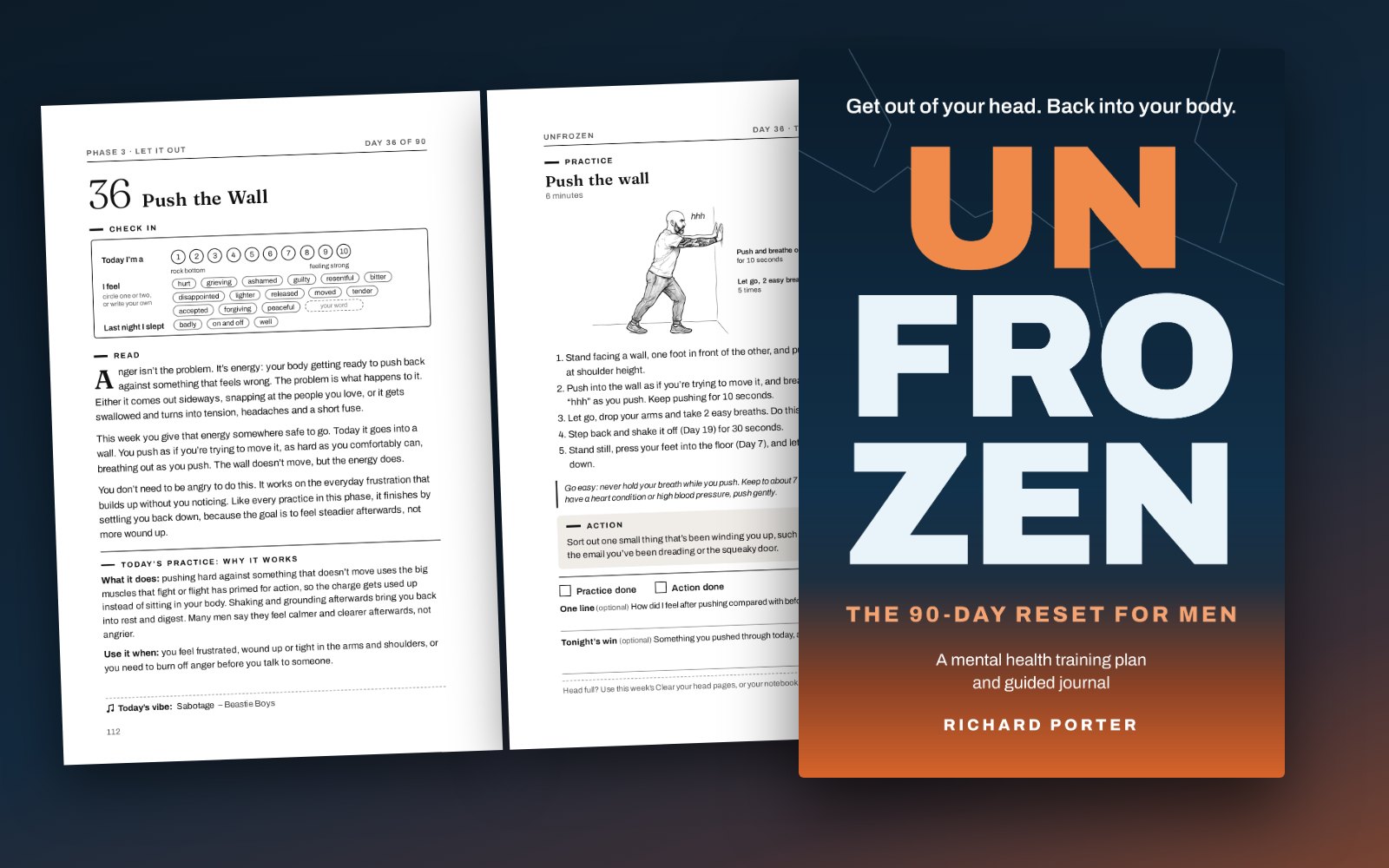
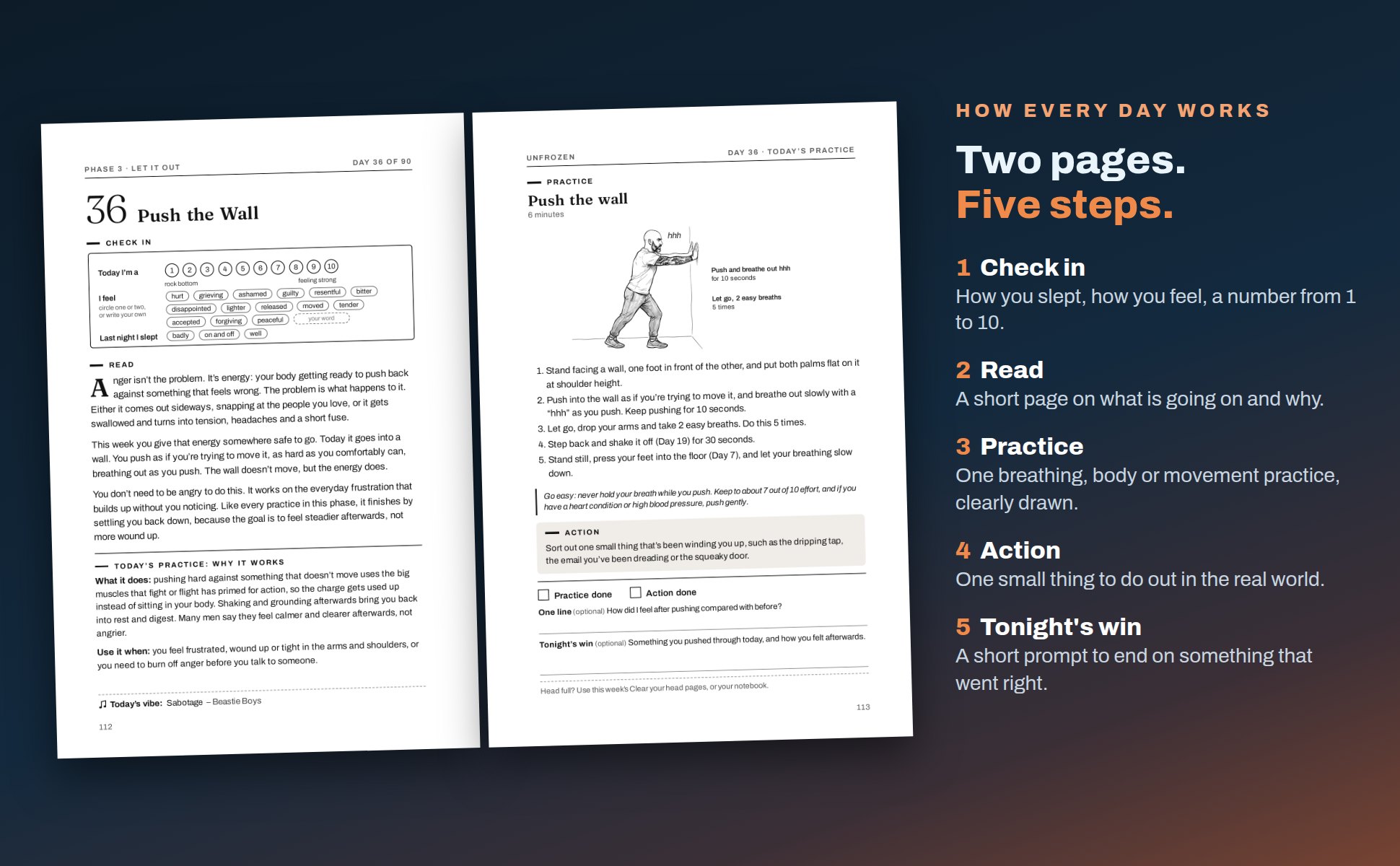
Unfrozen: The 90-Day Reset for Men is built to carry you through that stretch. It gives you two pages a day, about ten minutes, with a check-in, one practice, one small action and a weekly review, so there’s a written record of what is shifting, even on days when it feels like nothing is. The phases move from Stop the Slide (sleep, food and breath) to Back in Your Body, then Let It Out, so you aren’t rushed into feelings you aren’t ready for.
When to get help now
If you feel hopeless, or are having thoughts of ending your life, talk to someone today.
Samaritans: call 116 123, free, day or night.
Shout: text SHOUT to 85258, free, confidential, 24/7.
CALM: call 0800 58 58 58, 5pm to midnight, every day.
NHS 111: in England, choose the mental health option. In Wales, call 111 and press 2. In Scotland, call NHS 24 on 111 and choose option 2. In an emergency, call 999 or go to A&E.
Northern Ireland: Lifeline, 0808 808 8000, free, 24 hours a day.
Andy’s Man Club: free talking groups for men, Mondays from 7pm (not bank holidays), across the UK and online.
If you have felt numb for more than two weeks, see your GP, because it can be a sign of depression, and that’s treatable.
Questions
Plain answers.
Why do I feel numb all the time?
How do I stop feeling emotionally numb?
Is feeling numb a sign of depression?
Do men feel emotionally numb more than women?
Prefer to do this in a room with other people? See upcoming sessions in Preston, South Ribble and Chorley
Written by Richard Porter, somatic bodywork facilitator, Preston, Lancashire. This page is for information, not medical advice.
More questions men ask: Functional freeze · Signs of depression in men · Survival mode · How to be a better man · Feeling stuck in life
One small step at a time.
Unfrozen: The 90-Day Reset for Men. Paperback, 282 pages.
Available on Amazon in the UK.
Buy on Amazon