Be the first to hear about new events as they drop.Be first to hear about new events.
Thank you. Check your inbox and click the link to confirm.
WHAT TO CHECK FOR
The signs, before it has a name.
Stress and burnout can look identical from the outside. You’re tired, you’re short-tempered, you’re getting through the week rather than living it. The difference isn’t how bad it feels. It’s whether it lifts when the pressure does.

Stress lifts when the pressure does. This doesn’t.
A hard week has an edge to it. Too much to do, a deadline, a difficult conversation. It’s unpleasant while it’s happening, and then the week ends and you feel roughly like yourself again by the following Monday.
Burnout doesn’t lift like that. It isn’t one bad week, it’s months of them, and rest stops being the thing that fixes it. You can take the holiday, switch your phone off completely, come back ten days later, and still feel exactly the way you did when you left. That’s the actual tell, not how bad a day feels, but whether a good day off still works.
Here’s what to actually check, instead of guessing. None of these are dramatic on their own. That’s rather the point. Burnout arrives in a way that’s easy to explain away, one sign at a time.

The physical and mental signs
Your days off don’t feel like days off. You come back from a week away exactly as tired as you left. Rest used to work. It’s stopped working.
You’ve stopped finishing your own sentences. Not out loud. In your head. You know roughly what you were going to think, and you don’t bother finishing it.
Your body is keeping a list yours isn’t. A jaw that’s set before you’ve noticed. A stomach that’s off more days than not. The same headache, in the same place, most afternoons.
You’ve gone from the one who remembers everything to forgetting things you never used to. Not big things. The small, automatic ones. That’s what makes it register.
The emotional and behavioural signs
“I’m fine” comes out before the question does. It’s shorter than the real answer, and most days it isn’t even a lie so much as the fastest way through a conversation you don’t have the energy for.
Small admin sits there for days. Not because it’s hard. A form, an email, one phone call, ten minutes of work that sits there for a week, because you can’t face starting it.
You laugh, and notice, slightly late, that you didn’t feel it. The reaction still happens. The feeling underneath it has gone quiet.
You’d rather cancel than explain why you’re cancelling. Even to people who’d understand. Explaining costs more than staying in feels worth.
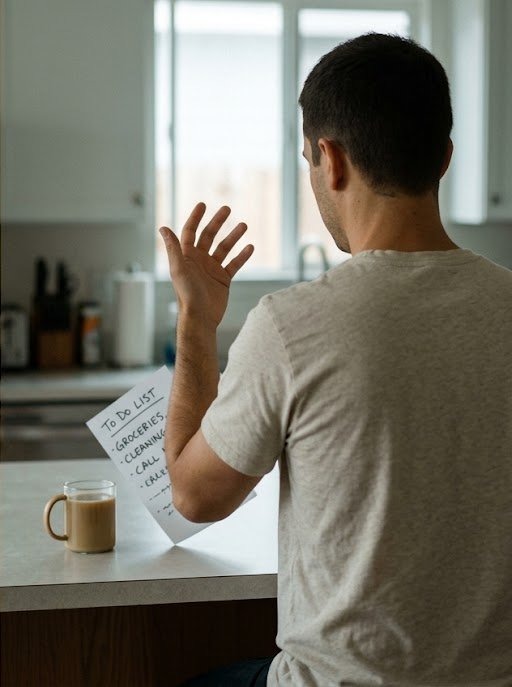
These aren’t random. A nervous system that has been switched on for months doesn’t have a spare setting left for rest, humour or memory. It spends everything on staying alert. There’s nothing left over for the rest of you.
This isn’t a diagnosis, and it isn’t trying to be one. It’s just easier to see something once it’s been named.
None of this means something is broken. It means something has been running a long time without a break.
What people usually try first
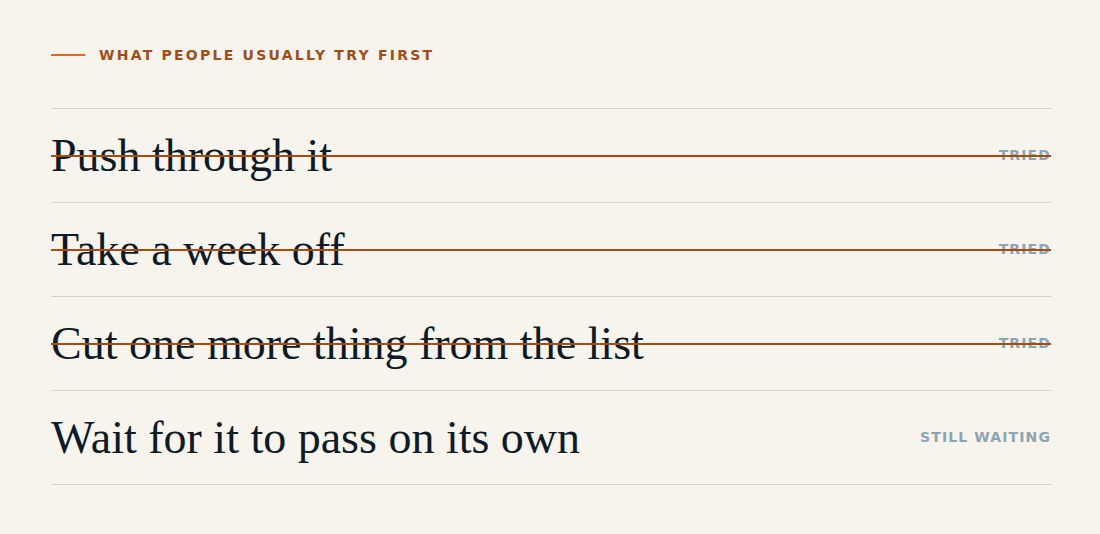
Before any of this had a name, you’d probably already tried a few of the obvious things. Worth being honest about why they didn’t hold, it isn’t a willpower problem.
Push through it. This is the default, and it’s also how most people end up here in the first place. Pushing through is what got you to burnout, not a way out of it.
Take a week off. Real rest, if you get an actual week and switch off properly. It helps with tiredness, which is part of this. It doesn’t reliably touch the rest of it, because the thing that’s stuck on doesn’t know the calendar has changed.
Cut one more thing from the list. Sensible, and it buys a little room. It doesn’t touch why everything still on the list now feels heavier than it used to.
Wait for it to pass on its own. The most common one, and the reason people are often well into this for months or years before they look it up. It doesn’t pass on its own, because nothing has told the nervous system it’s safe to stand down.
None of that means those were the wrong instincts. It means the thing driving this doesn’t respond to any of them directly.
What actually shifts it
If explaining it hasn’t shifted it, that’s not a personal failing. It’s the wrong tool for this particular job. A nervous system that’s been on for months doesn’t stand down because it understands the situation better. It stands down when something tells it, directly, that it’s safe to.
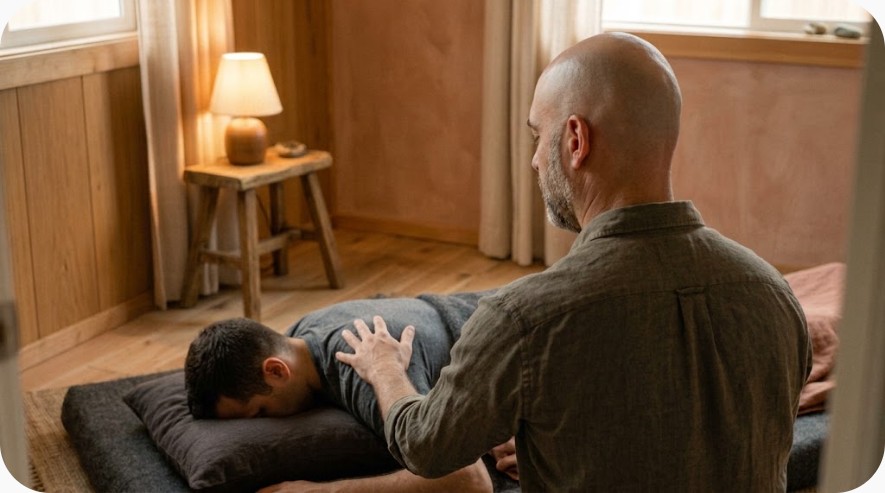
That’s the part talking doesn’t reach, and rest alone doesn’t either. It’s also the actual work: attention paid to the body itself, not as a metaphor, with someone else in the room, until something that’s been braced for a long time gets to unbrace. Not instantly, and not the same for everyone. It’s a different lever to the ones already tried, which is usually the point people are ready to try it.
If you are a man reading this.
Men tend to spot burnout last. We call it being busy, being tired or being short with people, and we deal with it through a few more drinks, a bet or longer hours rather than by saying anything. I did exactly that for years.
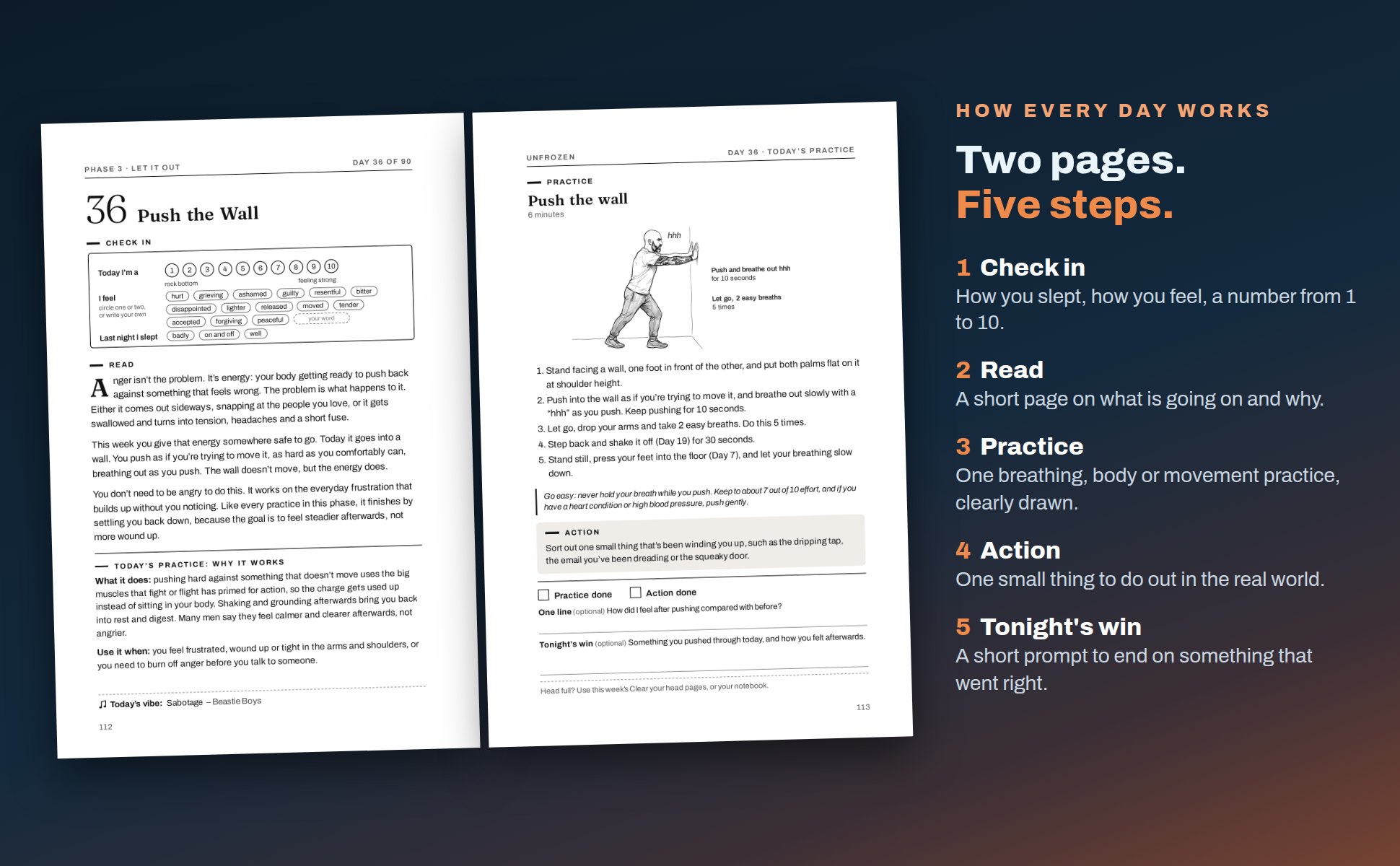
If several of these signs landed and talking about it is not where you are yet, my book is a place to start on your own. Unfrozen: The 90-Day Reset for Men gives you two pages a day, about ten minutes, with one breathing, body or movement practice, one small action and a weekly review that shows you what is changing.
FAQ
A few questions people ask.
Can you have burnout without a breakdown?
Is it still burnout if only one or two of these signs apply?
Does resting fix burnout?
Is burnout only a work thing?
How is burnout different from depression?
How long does it take to recover from burnout?
Best case, it’s the bit that finally makes sense of the others.
If two or three of these landed, the fuller picture of why is worth reading too. Read the wall, and what it costs
Or skip straight to what that actually looks like in practice. Here’s what happens in the room